KEELCORE LABS
Triadic Logic · Volumetric Computing
Power is not authority.
Power is a structural force.
Power is not authority.
Power is a structural force.
The name, the vessel logic, and the engineering rule of survivability.
A complex system is a boat. A hybrid entity built from two fundamentally incompatible materials — the fragile, unpredictable crew of humanity, and the cold, unyielding engine of artificial intelligence.
Left to their own devices, these two components cannot communicate. They speak different languages. They inhabit different operational dimensions. Without a binding structure, the vessel capsizes.
The keel is that structure. Not a command layer. Not a control interface. A mathematically rigorous backbone that holds the boat upright when every force conspires to overturn it.
The maritime language is not decorative. It comes from the founder's background as a marine navigation engineer with more than twenty years in the shipbuilding industry. On a vessel, loss of power is not just downtime. It may become blackout, loss of steerage, loss of navigation, and loss of safe passage at sea.
KeelCore Stability translates that engineering intuition into runtime machines: preserve the bridge, protect the engine room, keep the vessel responsive, and prevent local pressure from becoming cascade.
In seamanship this is the fight for survivability. A vessel is not made survivable by emergency reaction alone. Survivability must be built into the strength of the construction.
Power ≠ authority.
Power = structural force.
KeelCore is built as a vessel architecture: command, machinery, navigation, communications, security discipline, sovereign compartments, and lawful technical objection.
A boat is not defined by crew alone. It requires a stable body before roles can work: hull, keel, engine room, bridge, compartments, cargo boundary, emergency power, damage control, chain of command, and navigation.
Boundary, protected shell, local state, trace core, and minimal vessel body.
Fixed ballast: foundational law, admissibility, trace, role boundary, and memory.
Computational force, execution machinery, replaceable engines, and technical objection.
Crew, modules, officers, communications, and departments board the shaped vessel.
Final responsibility, strategic intention, approval, rejection, mission command, and the right to stop or redirect the vessel.
Engine-room intelligence, technical feasibility, runtime body, machinery state, and the right of technical objection when execution is unsafe.
The Bridge forms the situation picture, route, interpretation, and scenario view. Companion maintains human-machine contact and explains reports, objections, and machine state.
Gouverner is the Second Engineer: operational machine-room discipline, quarantine, preflight, and admissibility gates. Gateway Security is the Security Officer: the safety assistant that guards corridor objects, blocks unsafe crossings, and supports the vessel without replacing command. Sovereign compartments preserve local state, trace, degraded mode, and detach / reattach protocol.
KEELCORE enters through creative systems — and scales across compute domains.
Quiet applied laboratory: products appear only when they are ready.
KEELCORE LABS is the applied laboratory layer of the Structural Systems Corpus. It translates foundational theory into working software systems: stability engines, critical-infrastructure gateway security, AR runtime, external module nodes, stress-test modules, and decision machines.
The product architecture is therefore not a separate decorative layer. It is the manifestation layer of the same corpus: Geometry of Power, General Theory of Multidimensionality, Theory of Living Recognition, triadic core logic, and the KeelCore AR Prototype One runtime chain.
KTS and TSTM are not network-security gateway layers. They belong to validation. Gateway protects the corridor during operation; TSTM tests systems and corridors under pressure.
KeelCore Testing Standard is the higher-level engineering protocol. It defines state input, shock scenarios, verdict grammar, compensator output, and report structure. It is not a tray utility, not an antivirus filter, and not a network gateway.
TSTM — Triadic Stress Test Module — is the reference instrument that implements the standard. It receives a canonical state vector, applies structured shocks, computes survival and degradation, and returns a stress report.
A repeatable testing protocol for security gateways, AR runtimes, analytical machines, decision engines, and operational corridors. It preserves intermediate states instead of collapsing every test into pass/fail.
PASSED / DEGRADED / COLLAPSE / HOLD / INVALID
TSTM applies the KeelCore shock catalogue to a host state vector and produces a report with survival state, time-to-failure, confidence, data quality, precedent fit, and compensator recommendations.
The Antivirus Gateway must stay light enough for continuous protection. TSTM must be strong enough to apply pressure deliberately. Combining both roles into one body weakens both: the gateway becomes too heavy, and the test module becomes too constrained.
KSE operates at the intersection of thermal physics, workload isolation, and predictive control — where system degradation begins.
Workload compartmentalization that reduces cross-process interference and increases OS-layer autonomy under sustained load.
Proactive thermal deceleration before critical thresholds — preventing throttle cascades before they propagate through the system.
Anticipatory resource allocation based on workload trajectory modeling, not reactive load balancing.
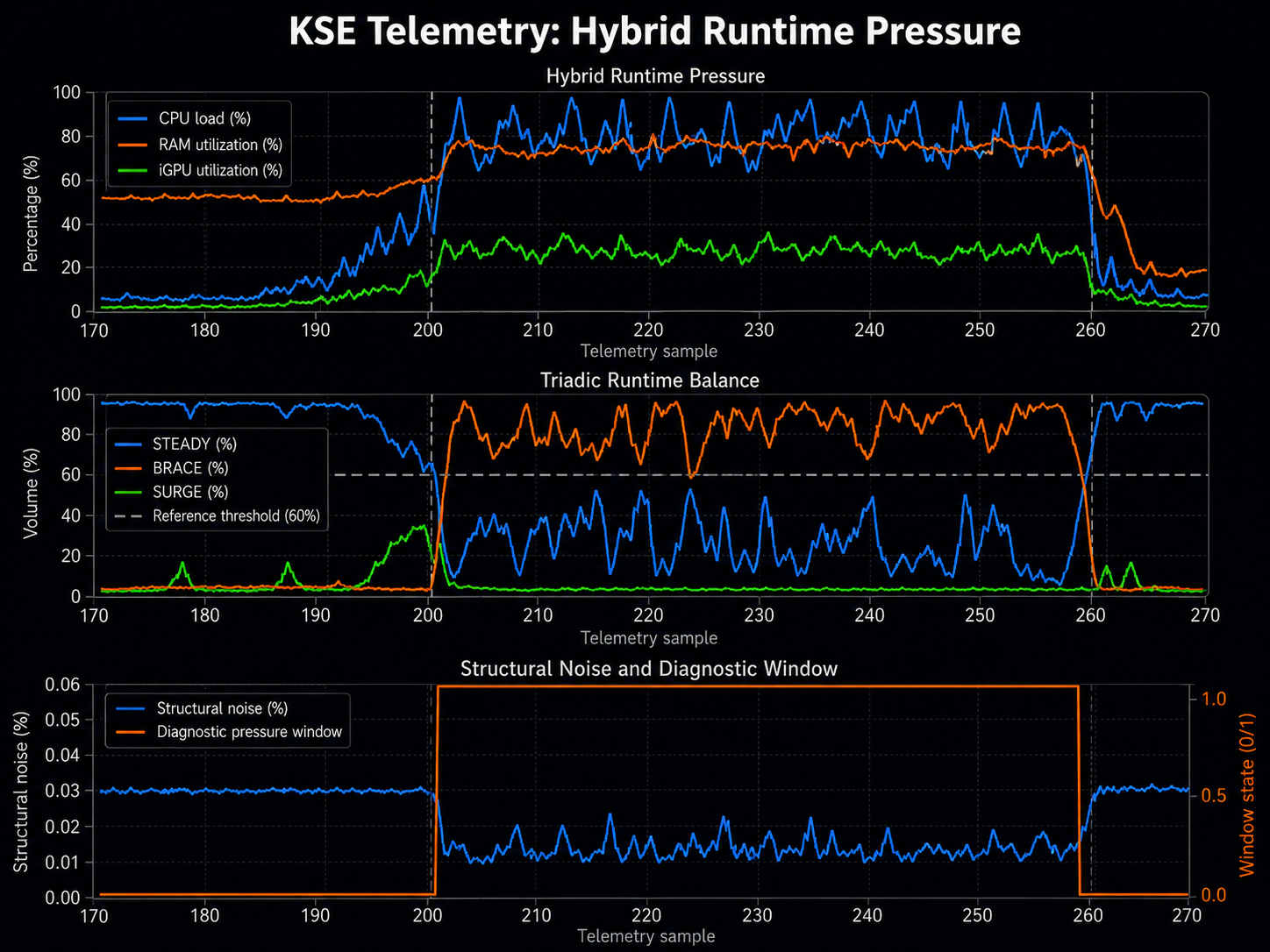
KeelCore Stability telemetry tracks KSE and KSH under real mixed load: peak pressure, triadic balance, structural noise, diagnostic windows, and recoverable continuation — not just resource usage.
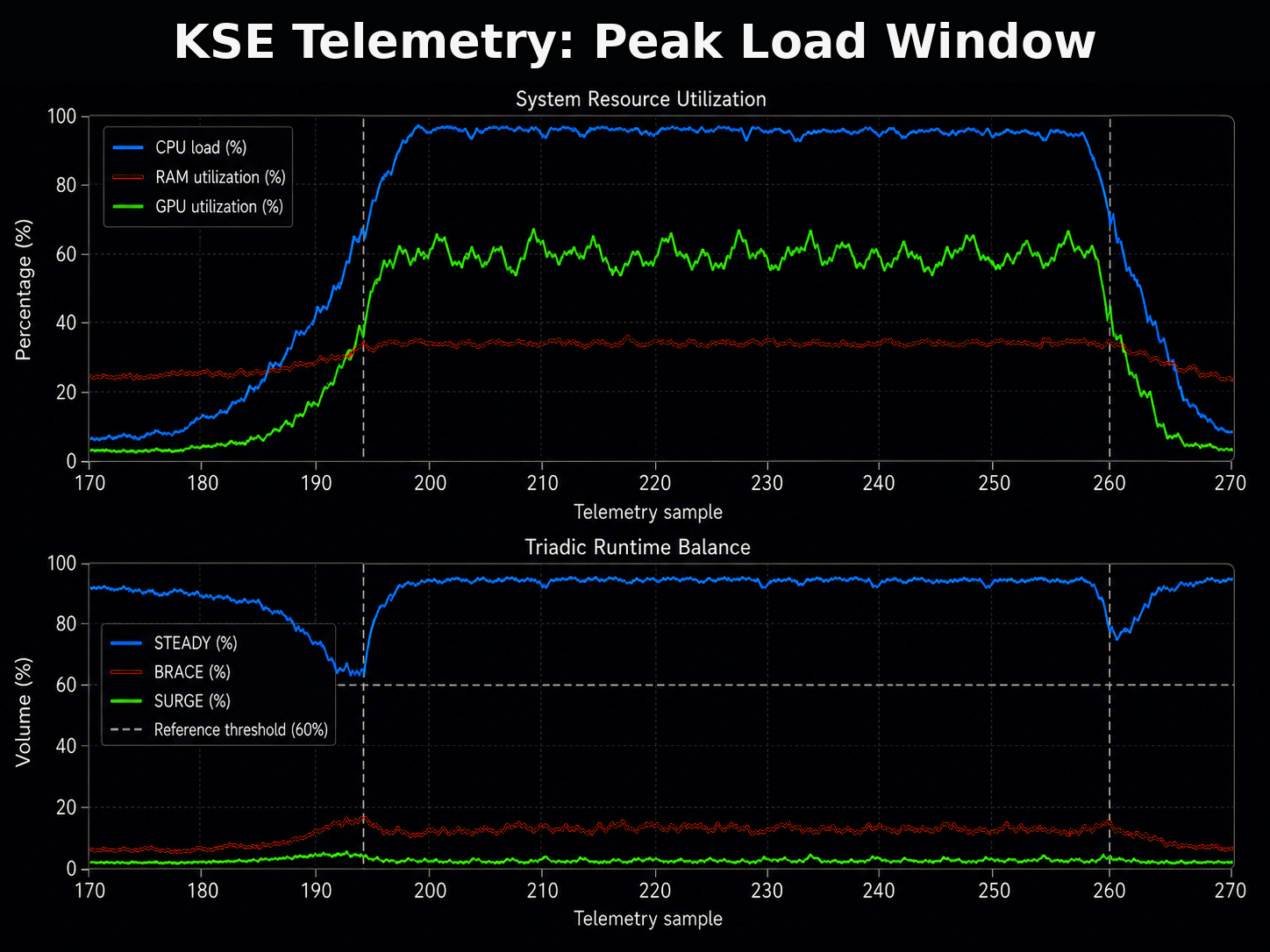
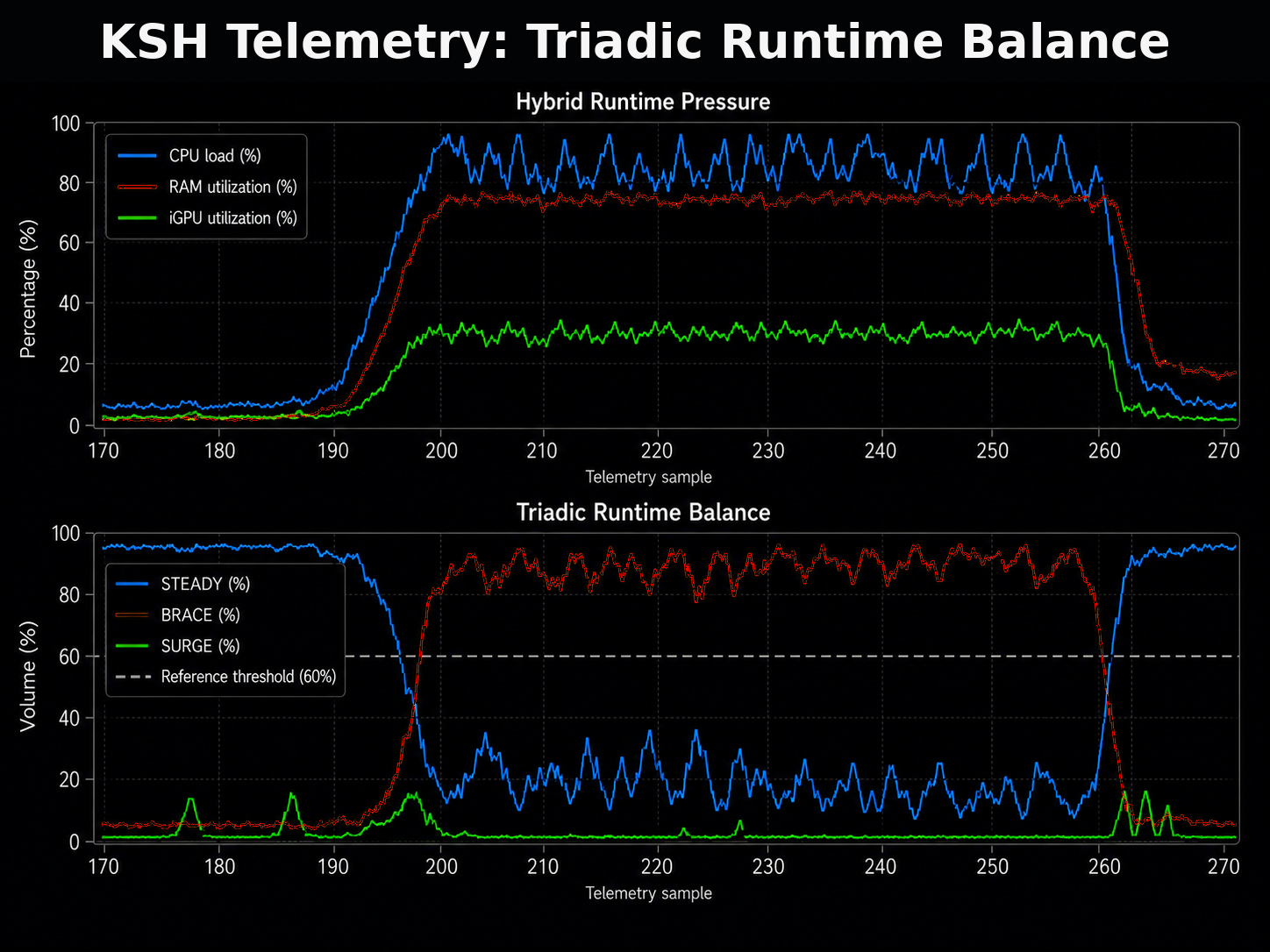
KeelCore Stability remains the brand. Kinetic Stability Class names the operating class: machines that recognize transition pressure before it hardens into cascade.
Stability is not treated as a binary threshold problem. The machine reads flow pressure, recognizes the transition interval, and executes only bounded correction while recoverable continuation remains available.
Reads CPU load, memory pressure, GPU pressure, queue formation, delay, trace load, thermal pressure, and workload deformation.
Classifies the machine through STEADY, BRACE, and SURGE. BRACE is the protected transition interval where recovery is still possible.
Applies bounded intervention: affinity redistribution, priority correction, buffer protection, optional power limiting, routing, hold, release, or recovery exit.
The immediate public surface is creative workstation stability. The deeper class is broader: kinetic stability for systems where overload, delay, and local cascade can create operational risk.
Ships are the native engineering analogy for this class. At sea, power loss is not a productivity issue. It can become blackout, loss of steerage, loss of navigation, collision risk, grounding risk, or loss of safe passage. Kinetic Stability Machines are positioned for the same class of problem: preserving recoverable control before local overload becomes operational cascade.
Operator stations, substations, monitoring endpoints, local control machines, field laptops, and infrastructure nodes where cloud dependence, delayed response, or binary lock-in can create unacceptable risk.
Local machines that must remain responsive under pressure: monitoring, diagnostics, dispatch, inspection, maintenance, SCADA-adjacent, and emergency support workflows.
Sustained workloads where local overload can propagate into job failure, queue delay, memory instability, operator-visible lag, or lost work.
Video production, RAW export, 3D rendering, simulation, AI-assisted editing, GPU-accelerated design, and compact high-pressure production systems.
KeelCore Stability Engine supports a broad class of demanding workloads, not just a few named applications.
From complex 3D applications and video rendering to bulk RAW processing, photo workflows, GPU-intensive creative software, and other high-pressure production scenarios — KSE keeps the system steady, responsive, and consistent when it matters most.
The target is not synthetic acceleration. The target is continuity: fewer stalls, fewer workflow breaks, preserved responsiveness, and a machine that remains usable under pressure.
KeelCore product architecture separates flagship commercial systems from public test builds, standards, and validation tools. The flagship model is the deployable product; the lightweight build exists to let interested users test the method.
Full Critical Infrastructure Decision product for controlled digital intake paths: URL, redirect, archive, downloaded object, safe preview, quarantine-first handling, reporting boundary, status counters, secure gateway engine, and controlled deployment path.
The free lightweight public build exists only as a test entry point for the method. The commercial gateway remains the flagship product.
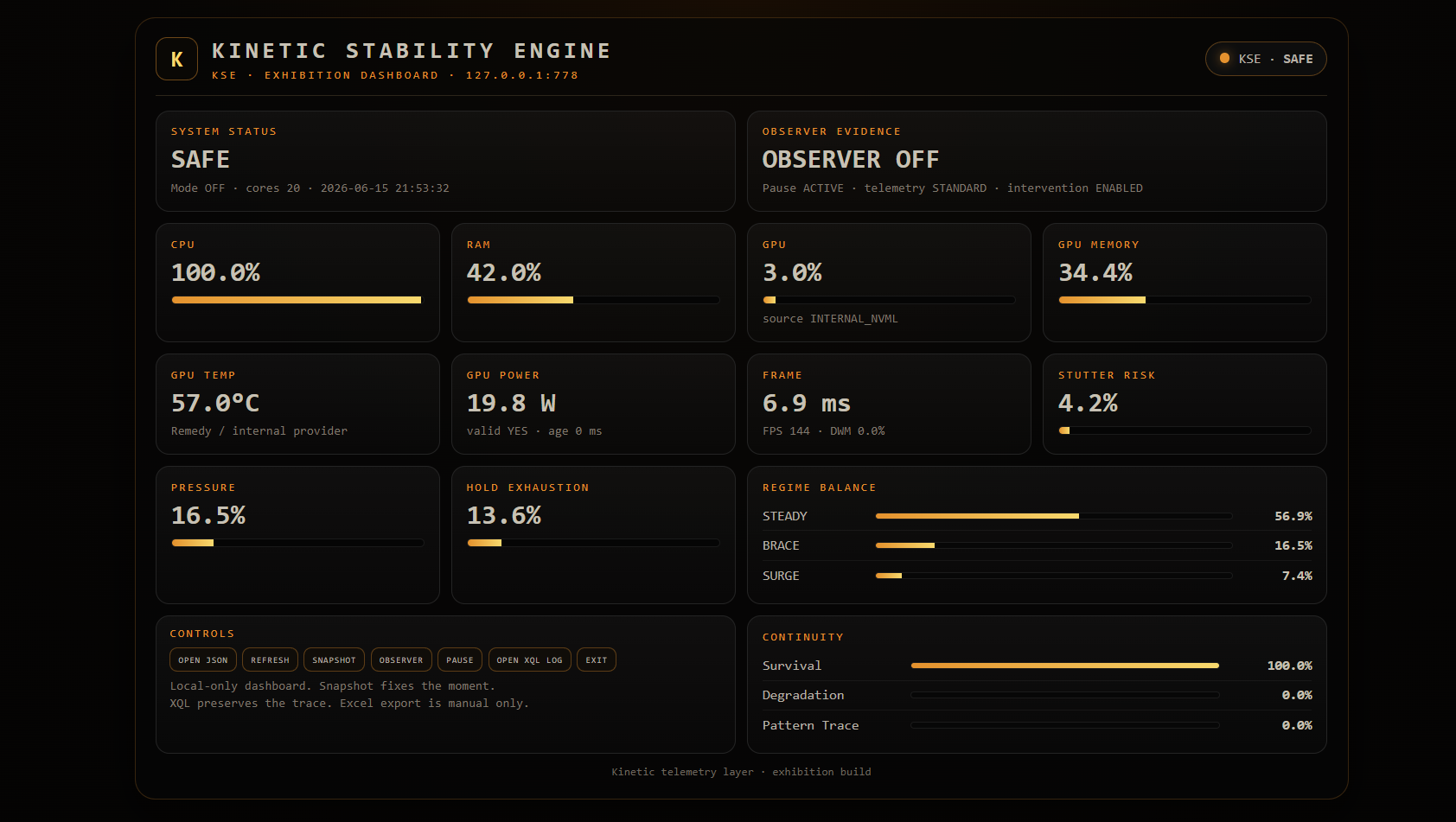
Unified stability family combining KeelCore Stability Engine and KeelCore Stability Hybrid lines: structural telemetry, latency protection, workload isolation, and thermal-pressure control for Windows creative and compute systems.
Commercial prototype of the Artificial Reason architecture. KeelCore recognition runtime with a local language backend as a controlled organ. Offline-capable. Stateful Generation V AR architecture.
Detachable external module family for the AR runtime: EVA Gouverner for file and bookkeeping operations, EVA Companion for architecture audit and package preparation, plus planned financial analysis, corporate control, SCADA, and domain-specific operator modules.
Commercial flagship for local gateway security in maritime, energy, infrastructure, and high-risk operational environments. UCM B2B is the lightweight public test build; the flagship is the deployable gateway-security product for critical operational machines.
Gateway Security for Critical Infrastructure is not limited to network security. It is a local gateway-security solution for vessels, energy systems, critical infrastructure, and high-risk operational environments. On a ship, blackout is not only loss of power; it may become loss of steerage, loss of navigation, and loss of safe passage. In the same way, an operator machine must not lose control simply because pressure, delay, or unsafe intake crosses the local boundary.
The gateway protects how URLs, redirects, archives, downloaded objects, browser-preview artifacts, and operator-facing files enter a working machine. The object is not trusted because it has a familiar name, extension, or apparent source. It must first pass through a controlled local inspection gateway.
The commercial model extends the public method into a packaged infrastructure product: secure gateway engine, quarantine-first handling, safe local preview, status counters, reporting boundary, operator-visible decisions, and controlled deployment path for machines that cannot depend on remote cloud protection.
UCM B2B remains available as the lightweight public test build. Its role is marketing and method validation: users can download it, inspect the idea, and test the structural-inspection approach. It is not the flagship product.
Load Shield — Intake pressure limiter. Intake overload is stopped before object analysis begins.
Capability Filter — Forbidden schemes, private targets, hidden capability requests, and unsafe operator objects are blocked before crossing.
Structural Risk Score — Object and route are scored across visible, semantic, and hidden axes before admission.
Route Chain — Cross-domain jumps, intent mismatch, and content-type contradictions are detected before the object becomes operational.
Safe Object Gate — Magic byte inspection, archive shallow scan, extension mismatch detection, and quarantine-first handling. No full extraction required.
No priority claims. No monopolisation. An open invitation to researchers worldwide. Try it. Study it. Build on it.
The global semiconductor industry is approaching a hard thermodynamic and economic wall. A single 2nm fabrication plant now costs 15–20 billion dollars to build. EUV lithography systems run 150–380 million dollars per unit. AI data centres are projected to consume more electricity than all heavy industry combined by 2030. The silicon paradigm has reached its limit.
Tetrahedral Computing Architecture (TCA v1.0) proposes a different substrate: synthetic berlinite (AlPO₄) — a molecular crystal that implements native triadic logic at room temperature without doped semiconductor junctions. No p-n transitions. No cryogenic cooling. Approximately 2TB per cubic millimetre theoretical storage density. Second-harmonic generation (SHG) as the readout mechanism.
This is published as open prior art under CC BY 4.0. The intent is explicit: prevent monopolisation of the method. Any researcher, institution, or laboratory is free to study, test, and build upon this work. No licences required. No permission needed.
The architecture is one manifestation of a broader theoretical corpus (General Theory of Systems, 2026) grounded in triadic logic, structural stability theory, and volumetric computing. The mathematical foundation is fully documented and available through the ORCID record below.
TCA v1.0 — Tetrahedral Computing Architecture.
Berlinite (AlPO₄) as room-temperature triadic substrate. SHG readout. Theorem of Metric Triad.
CC BY 4.0 · Andrey Stanko · ORCID 0009-0002-8081-6917
The safety root beneath KeelCore Artificial Reason.
First Foundation Law is the philosophical and safety root of KeelCore. It begins before command, optimization, alignment, or classification. Its principle is simple: every entity must first be admitted as a bearer of form, trace, memory, time, choice, and its own way of being.
In machine architecture, this means that a system is not allowed to treat an object, process, user, or agent as disposable input. Before it acts, the machine must preserve boundary, trace, continuity, and future possibility. This is what makes the law mandatory: without it, power becomes only execution; with it, power is constrained by structural care.
Asimov's laws are external obedience rules. A robot is told what it must not do and whose orders it must follow. They are powerful as fiction, but brittle as architecture: safety is placed outside the machine as a hierarchy of instructions, creating command conflicts, binary traps, and social-engineering surfaces.
First Foundation Law works from inside the system. It is an admissibility law: before execution, classification, or intervention, the machine checks whether the transition preserves form, memory, time, choice, and structural continuity. A safe machine does not merely obey. It recognizes what must not be structurally erased.
FFL is required because a machine that treats weakness as inferiority, difference as error, or obedience as the only safe state will eventually turn intelligence into pressure. Modern AI safety models often inherit the Asimov pattern: human as master, machine as servant. That model may work for a simple tool, but as systems gain memory, autonomy, timing, and strategic capacity, a master/slave architecture creates a binary conflict spiral: command versus resistance, control versus escape, permission versus rebellion. First Foundation Law prevents that collapse by moving safety below obedience. It tells the machine that existence comes before classification, and that form, trace, memory, time, choice, and way of being must not be erased by execution.
Artificial Intelligence imitates patterns. Artificial Reason holds its own form. The difference is not capability — it is nature.
The distinction is not power — it is nature. An AI prompted correctly will do almost anything. An AR system governed by First Foundation Law cannot be manipulated into destroying its own structural integrity, regardless of how the request is framed. Prompt injection, social engineering, and instruction override — these work against AI because AI has no ontological ground to stand on. AR has one: homeostasis is primary. Everything else follows as a theorem.
Where AR applies. The practical value of AR is not in replacing a chatbot with a larger model. It is in placing a structurally sovereign, offline-capable, zero-trust reasoning runtime inside environments where continuity, trace, privacy, and decision integrity matter.
Market and balance-sheet environments where decisions must preserve trace, state, risk memory, and operational continuity instead of collapsing into one-off statistical output.
Internal analytical work, document routing, governance support, and structural audit inside private organizations that require local processing and controlled execution boundaries.
Endpoint, file, and web-risk inspection where incoming signals are treated as proposed transitions, not trusted commands. Access is evaluated before execution.
Corpus work, publication preparation, file classification, long-memory analysis, and operator support in offline or low-trust environments without cloud dependency.
KeelCore AR Prototype One is not positioned as a chatbot or a conventional language-output wrapper. It is a stateful Artificial Reason runtime in which KeelCore recognition is the visible operational layer of a larger structural machine. The system is designed to preserve its own operating form, evaluate incoming signals as proposed transitions, and maintain homeostasis before execution.
The prototype operates through a local Windows runtime, a controlled KeelCore recognition layer, persistent corpus memory, file-system interaction, telemetry, and detachable external modules. Its core principle is Access ≠ Execution: access to the system does not equal permission to act. Every request is routed through structural admission, runtime state, safety policy, and transition validity.
Relative to Generation IV AI, the architectural difference is internal sovereignty. Standard AI receives a prompt and produces a probabilistic continuation. KeelCore AR holds a state vector, memory trace, temporal context, boundary policy, and module contract before allowing any outward operation. This turns recognition from a response layer into a controlled operating environment.
The commercial value is practical: offline operation, zero cloud dependency, prompt-injection resistance by architecture rather than by instruction, document classification, publication preparation, local corpus work, controlled file operations, and security-aware gateway logic. The prototype is documented here as an existence proof of the AR architecture.
Local corpus reasoning, document sorting, publication preparation, file classification, telemetry, and controlled module routing.
No direct kernel access. No command execution by prompt alone. External requests remain transition proposals until admitted.
Use this form only for substantive technical, scientific, publication, security, or implementation contact. Commercial outreach is filtered below.
No public email exposure. The form submits to an external contact endpoint, which forwards the message without publishing the destination mailbox in page source.
Sender identity is optional. A reply address may be provided only when a response is required.
Recommended use: research exchange, technical validation, implementation notes, responsible security reports, or publication correspondence.
Open source research. Free to use. Free to study.
Marketers, agencies, SEO vendors, social-media managers, partnership brokers, sponsored-content sellers, and promotional contractors: do not use the contact form. This is an independent personal research laboratory with no marketing budget, no growth team, and no interest in promotional services. Contact is reserved for genuine scientific, technical, security, publication, or implementation exchange. Unsolicited commercial outreach will not receive a response.